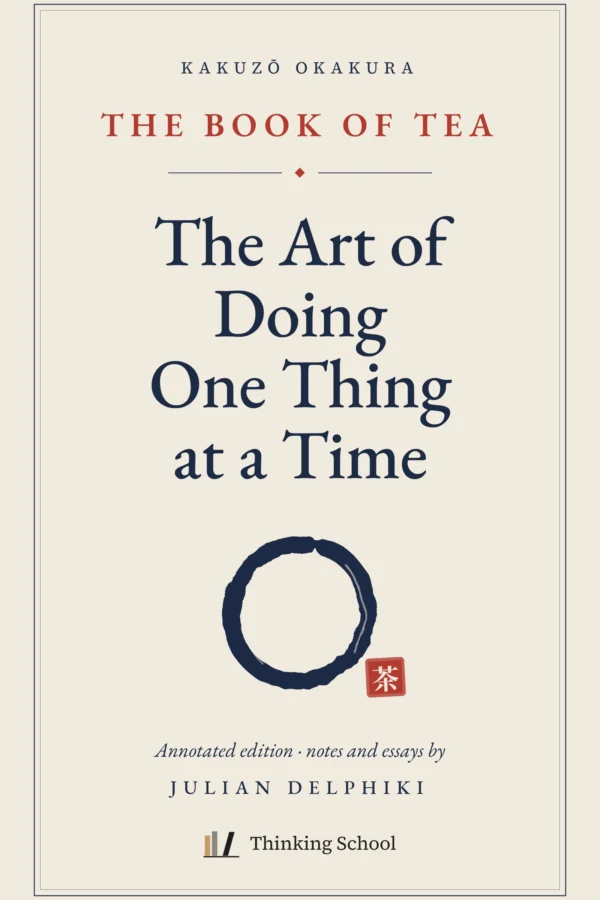
Okakura Kakuzō wrote The Book of Tea in English, in Boston, and published it in New York in 1906 while Japan’s war with Russia was fresh in Western minds. It is not a Japanese treatise in translation. It is a plea addressed to American readers, explaining the tea ceremony, Taoism and Zen, the tea-room, flowers and the tea masters in the West’s own words. When Okakura says “we”, he means Asia talking to the West.
This edition reads it as something else as well: a treatise on attention. “One cannot listen to different pieces of music at the same time,” Okakura wrote. The fifteen essays ask what that sentence means for people who try to do exactly that every day.
The fifteen essays
The first, “Two Pieces of Music at Once”, traces multitasking to a word borrowed from computing. Others look at the forty-seven seconds people now spend on a screen before switching, who interrupts whom at work, empty space, what is left unsaid, thresholds that mark the start and end of a day, the urge to classify, flow and its twin, host and guest, outsourced multitasking with AI agents, silence, an object kept for years, and the packaging of Zen for boardrooms. The last one turns that suspicion on this book.
Why this edition of The Book of Tea
The 1906 text is in the public domain and free online, and the free copies are faithful to Okakura’s English. What they lack is a guide: who the people and schools Okakura names were, where he simplifies or idealises, and what the book was arguing against in 1906. This edition supplies that in 71 notes and a context chapter, keeps Okakura’s complete text in Part One, and puts the modern essays in Part Two with their sources. A counterpoints chapter and an epilogue that offers options, not promises, close the book. You can search Project Gutenberg for free versions.
Contents of The Book of Tea
- Preface: one thing
- Context: a Japanese man in Boston
- Part One: The Book of Tea, chapters I–VII, annotated
- Part Two: fifteen essays
- Part Three: counterpoints and epilogue
- Further reading
Edition details
| Author | Julian Delphiki (new essays); see how essay editions are made |
|---|---|
| Classic text | Kakuzō Okakura, The Book of Tea (New York: Fox, Duffield & Company, 1906) |
| Notes | 71 new notes |
| Modern essays | Fifteen, by Julian Delphiki |
| Length | 206 pages in paperback |
| Languages | English; Spanish edition as El libro del té, in a new translation |
The printable PDF
| Format | PDF, made for home printing and on-screen reading |
|---|---|
| Page size | 6 × 9 in (15,2 × 22,9 cm) |
| Pages | 207 (English), 207 (Spanish) |
| Language | English and Spanish (both files included) |
| File size | 1,4 MB in total |
| Edition | November 2026 |
| Price | 3,99 €, VAT included |
| Delivery | Download links on the confirmation page and by email, straight after payment |
Fonts are embedded and the file opens with bookmarks for each chapter, so it prints the same on any printer. No DRM. Download each file up to five times within a year of purchase.
Buying the PDF
What do I get for 3,99 €?
Two PDF files of The Book of Tea, Annotated, one in English and one in Spanish, both complete. You download them as soon as the payment goes through.
Will it print well at home?
Yes. The page is 6 × 9 in (15,2 × 22,9 cm), the size of the paperback. Print it at 100% on A4 or US Letter and trim, or print two pages per sheet for a reading copy. Fonts are embedded, so the type stays sharp.
Do I need a PayPal account?
No. At checkout PayPal also takes a debit or credit card as a guest.
How many times can I download it?
Five times within a year of purchase. Keep a copy on your own device and you can read and print it for as long as you like.
Can I get a refund?
Downloads start at once, so the legal 14-day withdrawal right ends when you download. If a file is faulty or will not open, write within 14 days and we will send a working file or refund you.