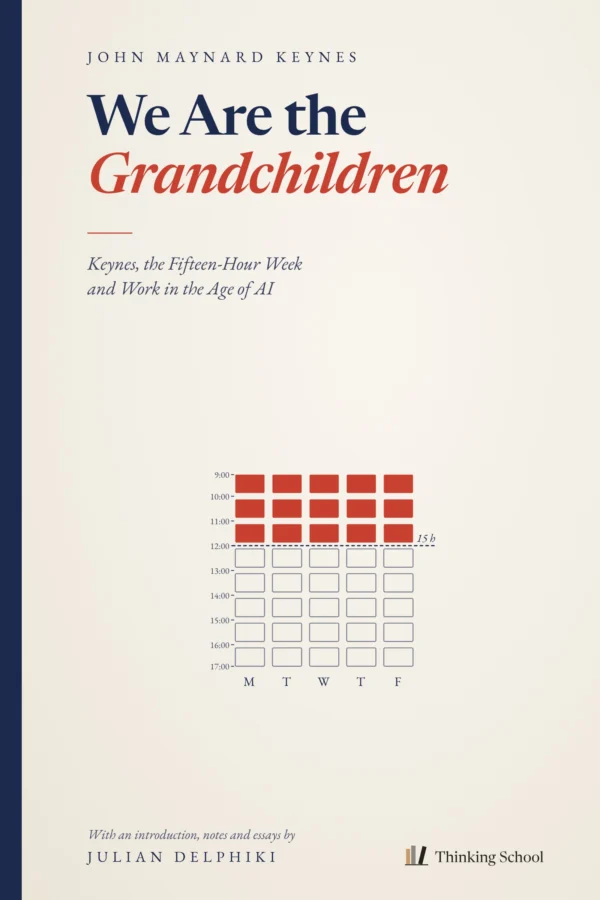
In 1930, with the world sliding into depression, Keynes put a date on abundance. Within a hundred years, he wrote, the economic problem would be solved or in sight, and his grandchildren could live well on about fifteen hours of work a week. He first gave the argument as a talk in Madrid on 10 June 1930. The essay appeared in The Nation and Athenaeum in October of that year and was collected in Essays in Persuasion in 1931.
The hundred years run out in 2030. The grandchildren are us. This book reads the prophecy as an audit: the wealth arrived, the free time did not. Julian Delphiki argues that the obstacle was never technical, and follows five leaks through which the time we gained escapes: efficiency spent on producing more, services that keep getting dearer, the fear of losing a job, status, and what we choose to measure.
What the essays examine
The twenty-four essays are grouped in three parts. “Hours and Money” includes the Michigan cereal factory that ran six-hour shifts for half a century, a look at the thirty-two-hour week, and the arithmetic of a fifty-three-week year. “Machines and Meaning” covers the many announced ends of work, the coal paradox of efficiency, Oscar Wilde’s mechanical slaves and the rich who no longer rest. “The Deadline” brings the argument to artificial intelligence and to what Keynes meant by unemployment. A chapter of counterpoints makes the best case against Keynes and against the book itself.
Why this edition of We Are the Grandchildren
Keynes’s essay is short and its text is in the public domain, so free copies circulate widely. They give you the essay alone. This edition sets it in context (who Keynes was in 1930, the Madrid lecture, what came after), adds the twenty-four essays, an epilogue, a postscript and an appendix with the sums behind the fifty-three-week year, and lists its sources. The modern essays are printed after the text, never mixed into it.
Contents of We Are the Grandchildren
- Prologue: four years to go
- Context: Madrid, 10 June 1930
- Part One: the text of “Economic Possibilities for our Grandchildren”
- Part Two: hours and money (essays 1–9)
- Part Three: machines and meaning (essays 10–19)
- Part Four: the deadline (essays 20–24)
- Counterpoints, epilogue, postscript, appendix, sources
Edition details
| Author | Julian Delphiki (new essays); see how essay editions are made |
|---|---|
| Classic text | John Maynard Keynes, “Economic Possibilities for our Grandchildren” (1930) |
| Modern essays | Twenty-four, by Julian Delphiki |
| Length | 206 pages in paperback |
| Languages | English; Spanish edition as Nuestros nietos somos nosotros |
The printable PDF
| Format | PDF, made for home printing and on-screen reading |
|---|---|
| Page size | 6 × 9 in (15,2 × 22,9 cm) |
| Pages | 207 (English), 217 (Spanish) |
| Language | English and Spanish (both files included) |
| File size | 1,4 MB in total |
| Edition | November 2026 |
| Price | 3,99 €, VAT included |
| Delivery | Download links on the confirmation page and by email, straight after payment |
Fonts are embedded and the file opens with bookmarks for each chapter, so it prints the same on any printer. No DRM. Download each file up to five times within a year of purchase.
Buying the PDF
What do I get for 3,99 €?
Two PDF files of We Are the Grandchildren, one in English and one in Spanish, both complete. You download them as soon as the payment goes through.
Will it print well at home?
Yes. The page is 6 × 9 in (15,2 × 22,9 cm), the size of the paperback. Print it at 100% on A4 or US Letter and trim, or print two pages per sheet for a reading copy. Fonts are embedded, so the type stays sharp.
Do I need a PayPal account?
No. At checkout PayPal also takes a debit or credit card as a guest.
How many times can I download it?
Five times within a year of purchase. Keep a copy on your own device and you can read and print it for as long as you like.
Can I get a refund?
Downloads start at once, so the legal 14-day withdrawal right ends when you download. If a file is faulty or will not open, write within 14 days and we will send a working file or refund you.