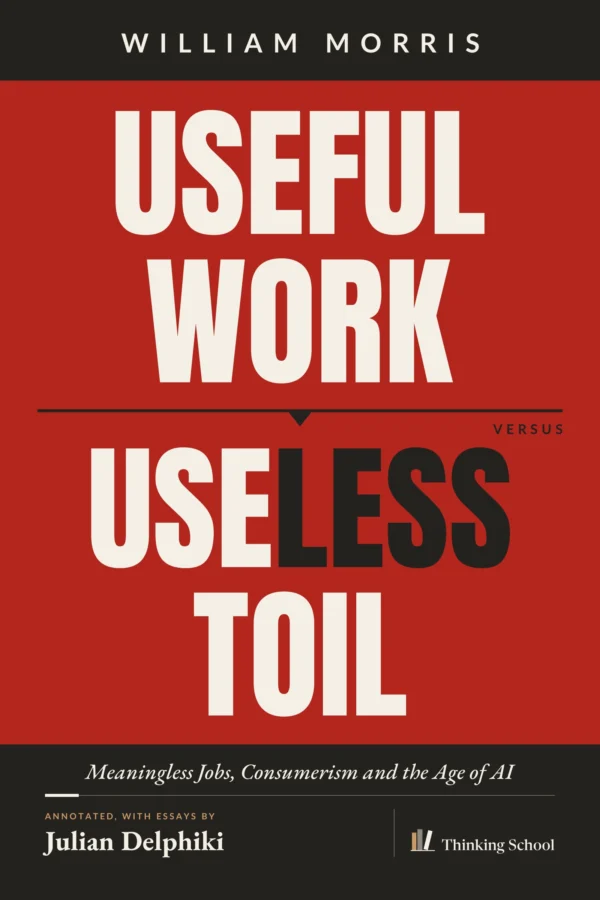
In 1884 the designer, poet and socialist William Morris gave a lecture that offered a pair of scales for weighing any kind of work. Worthwhile work, he argued, carries three hopes: the hope of rest, the hope of a product worth having, and the hope of pleasure in the work itself. Work without them is useless toil, which he called “mere toiling to live, that we may live to toil”.
The lecture was printed in 1885. This edition prints it complete and puts current work on Morris’s scales: surveys in which employees call their own jobs pointless, engagement figures, AI that adds to workloads instead of reducing them, and goods built to fail.
The twenty-one essays
The essays run in five parts, and each ends with a question for the scales. “Meaning” covers meaningless jobs, four kinds of estrangement, measuring work, and AI and the work that remains. “Craft” covers pride, the pleasure of doing one thing well, reheated culture, the school bell and Morris’s factory among gardens. “Things” covers consuming in order to work, planned obsolescence, the puffery of wares and the decent house. “The Commons” covers the work nobody wants, unpaid work, sharing tools and co-operation. “Life” closes with leisure and a life well spent.
Why this edition of Useful Work versus Useless Toil
The lecture is in the public domain and can be read free online. Free copies give the text alone. This edition adds annotations, a context chapter on how a rich boy from Walthamstow became a designer and then a socialist, a timeline, a glossary of Morris’s key words, and essays that test the argument with sources. Morris’s words are printed apart from the modern essays. You can search Project Gutenberg for free versions.
Contents of Useful Work versus Useless Toil
- Prologue: a pair of scales from 1884
- Context: the designer who became a socialist; timeline; key words
- The lecture, with notes
- Five parts of essays (I–XXI)
- Counterpoints, epilogue, further reading
Edition details
| Author | Julian Delphiki (new essays); see how essay editions are made |
|---|---|
| Classic text | William Morris, “Useful Work versus Useless Toil” (lecture, 1884) |
| Modern essays | Twenty-one, by Julian Delphiki |
| Length | 228 pages in paperback |
| Languages | English; Spanish edition as Trabajo útil, esfuerzo inútil |
The printable PDF
| Format | PDF, made for home printing and on-screen reading |
|---|---|
| Page size | 6 × 9 in (15,2 × 22,9 cm) |
| Pages | 229 (English), 243 (Spanish) |
| Language | English and Spanish (both files included) |
| File size | 1,6 MB in total |
| Edition | November 2026 |
| Price | 3,99 €, VAT included |
| Delivery | Download links on the confirmation page and by email, straight after payment |
Fonts are embedded and the file opens with bookmarks for each chapter, so it prints the same on any printer. No DRM. Download each file up to five times within a year of purchase.
Buying the PDF
What do I get for 3,99 €?
Two PDF files of Useful Work versus Useless Toil, Annotated, one in English and one in Spanish, both complete. You download them as soon as the payment goes through.
Will it print well at home?
Yes. The page is 6 × 9 in (15,2 × 22,9 cm), the size of the paperback. Print it at 100% on A4 or US Letter and trim, or print two pages per sheet for a reading copy. Fonts are embedded, so the type stays sharp.
Do I need a PayPal account?
No. At checkout PayPal also takes a debit or credit card as a guest.
How many times can I download it?
Five times within a year of purchase. Keep a copy on your own device and you can read and print it for as long as you like.
Can I get a refund?
Downloads start at once, so the legal 14-day withdrawal right ends when you download. If a file is faulty or will not open, write within 14 days and we will send a working file or refund you.