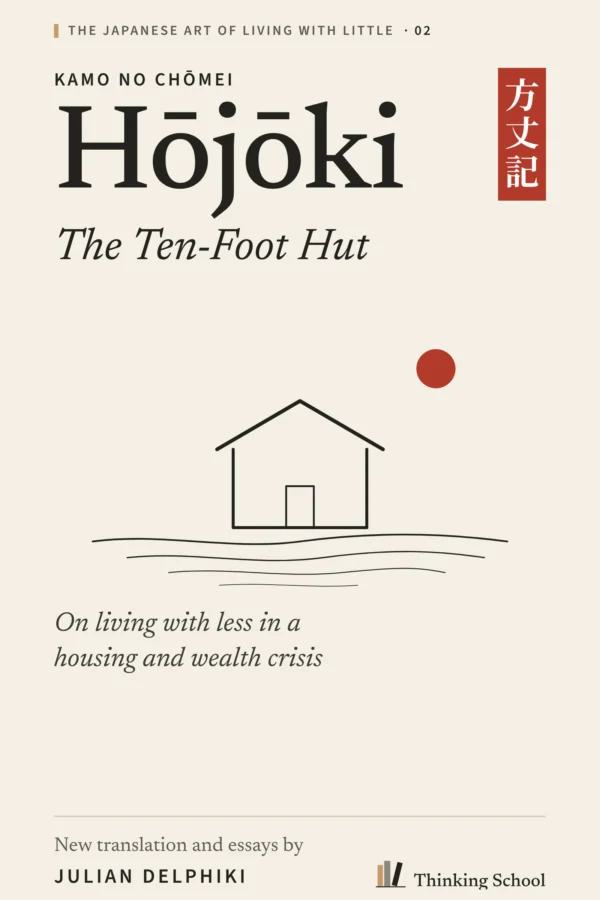
Before he retired to a hut in the hills at Hino, outside Kyoto, Kamo no Chōmei saw a third of the capital burn, a whirlwind flatten whole districts, the court move the capital and move it back, a famine fill the streets with the dead, and an earthquake. He lost his grandmother’s house, built another a tenth its size, and finally one a hundredth the size: a hut about ten feet square that could be taken apart and carried on two carts. In 1212 he wrote Hōjōki, the record of that hut.
The book reads it as a text about housing. The eighteen essays cross Chōmei with the housing and inequality crisis of the 2020s and ask a question he never had to: when is living small a choice, and when is it imposed?
The eighteen essays
The essays take their titles from Chōmei’s own images. The first argues that the hut is not a housing plan, and sets his chosen smallness beside homes that shrink because rents rise. Others follow houses that went down the river, a life that fits on two carts, how long a house lasts, inheritances nobody wants, the deposit, smoke from the hearths, the armoured house, living alone, the hut with Wi-Fi, catalogue minimalism and a temporary hut. A chapter of counterpoints and eighteen questions, “chosen or imposed”, close the book, with an epilogue on what can be done with a hundred square feet.
Why this edition of Hōjōki: The Ten-Foot Hut
Chōmei’s text is in the public domain, and older English translations can be read free online. They are short, and some are elegant. This edition offers a new translation from the classical Japanese, notes on names, places, measures and allusions, a context chapter on Kyoto between 1155 and 1216, and the modern essays printed after the text and kept separate from it. You can search Project Gutenberg for free versions.
Contents of Hōjōki: The Ten-Foot Hut
- Prologue: a hundred square feet and a question
- Context: Chōmei and Kyoto, 1155–1216
- The text: Hōjōki, in seventeen sections, with notes to the translation
- Essays
- Counterpoints; chosen or imposed: eighteen questions
- Epilogue, further reading
Edition details
| Author | Julian Delphiki (new essays); see how essay editions are made |
|---|---|
| Classic text | Kamo no Chōmei, Hōjōki (1212) |
| Translation | New translation from the classical Japanese, with notes |
| Modern essays | Eighteen, by Julian Delphiki |
| Length | 206 pages in paperback |
| Languages | English; Spanish edition as Hōjōki: una cabaña de tres metros |
The printable PDF
| Format | PDF, made for home printing and on-screen reading |
|---|---|
| Page size | 6 × 9 in (15,2 × 22,9 cm) |
| Pages | 207 (English), 219 (Spanish) |
| Language | English and Spanish (both files included) |
| File size | 1,2 MB in total |
| Edition | November 2026 |
| Price | 3,99 €, VAT included |
| Delivery | Download links on the confirmation page and by email, straight after payment |
Fonts are embedded and the file opens with bookmarks for each chapter, so it prints the same on any printer. No DRM. Download each file up to five times within a year of purchase.
Buying the PDF
What do I get for 3,99 €?
Two PDF files of Hōjōki: The Ten-Foot Hut, one in English and one in Spanish, both complete. You download them as soon as the payment goes through.
Will it print well at home?
Yes. The page is 6 × 9 in (15,2 × 22,9 cm), the size of the paperback. Print it at 100% on A4 or US Letter and trim, or print two pages per sheet for a reading copy. Fonts are embedded, so the type stays sharp.
Do I need a PayPal account?
No. At checkout PayPal also takes a debit or credit card as a guest.
How many times can I download it?
Five times within a year of purchase. Keep a copy on your own device and you can read and print it for as long as you like.
Can I get a refund?
Downloads start at once, so the legal 14-day withdrawal right ends when you download. If a file is faulty or will not open, write within 14 days and we will send a working file or refund you.